Monday, August 29, 2011
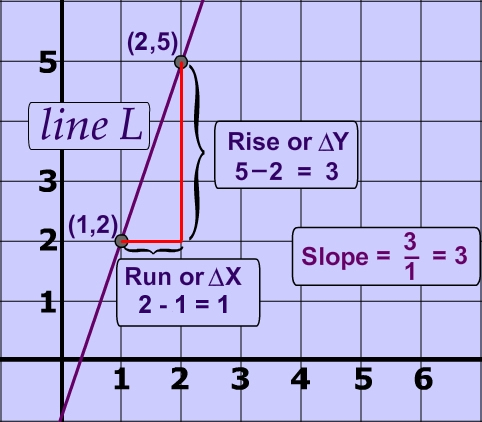
Hellen Romero c(:: average rate of change
Hellen Romero c(:: average rate of change: The change in the value of a quantity divided by the elapsed time.

Finding the zero's
Make sure you set the equation = 0 to find the zeros...don't plug in zero! That is entirely different...
If you are asked to find the zero of f(x) = 2x + 5
2x + 5 = 0...then solve for x.
x = -5/2
if you are asked f(x) = 2x + 5; f(0), then plug in zero...2(0) + 5 = 5
f(0) = 5, the zero of the function is -5/2
If you are asked to find the zero of f(x) = 2x + 5
2x + 5 = 0...then solve for x.
x = -5/2
if you are asked f(x) = 2x + 5; f(0), then plug in zero...2(0) + 5 = 5
f(0) = 5, the zero of the function is -5/2
How to Graph a linear equation

The y axis is the vertical axis....go to b (the number out there by itself), (0,b) and put a dot, then count the slope from that point...up/rt if it is positive, up/lt if it is negative
The slope is the coefficient (number in front of x) of x...just count up or down and over rt or lt...
up/rt or dn/lt is positive; up/lt or dn/rt is negative!
Friday, August 26, 2011

Subscribe to:
Posts (Atom)